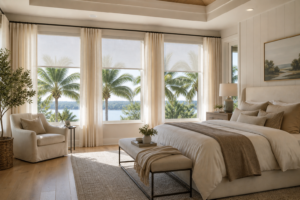
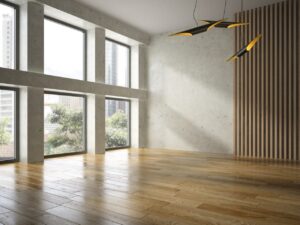
One common mistake homeowners make is choosing the same window treatment for every room. It feels cohesive, but it often backfires. Certain rooms end up with treatments that don’t match how the space actually gets used. Every room has different needs. A bedroom needs to block light. A bathroom needs to handle humidity. A living room needs to balance privacy with a welcoming feel. And in Florida, every room also faces intense sun and year-round heat that most states simply don’t deal with.
Here’s a room-by-room guide to help you make the right call.
Living Room: Balance Light, Privacy, and Style
The living room is where your window treatments make their biggest design statement. However, it’s also where the competing demands are strongest. You want natural light during the day, privacy in the evenings, and something that looks polished without feeling heavy.
Plantation shutters are a perennial favorite for Florida living rooms. They give you precise control over light angles. They hold up well in humid climates. Furthermore, they add an architectural quality that feels intentional rather than decorative. They also work beautifully with the coastal and transitional styles common in Spring Hill and the Tampa Bay area.
If shutters feel too structured, layered treatments are another strong option. A sheer roller shade paired with a soft linen panel, for example, gives you daytime privacy without blocking light while adding warmth and texture to the room, a popular choice.
Bedroom: Make Darkness a Priority
Most people underestimate how much sleep quality depends on light control. In Florida, where the sun rises early for much of the year, this matters even more.
Blackout shades are therefore the most practical choice for bedrooms. They block light almost entirely, which means better sleep especially in east-facing rooms that catch the morning sun. Cellular blackout shades also insulate well, which helps keep rooms cooler during warm Florida nights.
If you want something softer, a blackout Roman shade is a beautiful option. It gives you the light-blocking function you need while adding a tailored, finished look. Many homeowners also layer a sheer shade underneath for daytime use, so they get natural light during the day and complete darkness at night.
Kitchen: Prioritize Easy Cleaning and Moisture Resistance
Kitchens are tough on window treatments. Between steam, cooking grease, and daily use, whatever goes on a kitchen window needs to be practical first. As a result, heavy fabric options like Roman shades are generally not the best fit here.
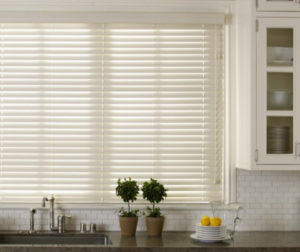
Faux wood blinds work really well in kitchens. They resist moisture, wipe clean easily, and come in finishes that complement cabinetry beautifully. Alternatively, a simple roller shade in a coated fabric gives you a clean, modern look that holds up well.
If your kitchen has a window over the sink, a café-style shutter covering only the lower half is a smart solution. It gives you privacy at eye level while still letting in plenty of light from above.
Bathroom: Humidity Changes Everything
Bathrooms are the one room where the wrong material causes real problems. Wood blinds can warp and crack over time in high humidity. Certain fabrics can also develop mildew if they’re regularly exposed to steam.
Consequently, the best choices for bathrooms handle moisture well. Faux wood blinds and PVC shutters look great, provide privacy, and won’t suffer from humidity the way natural wood can. Solar shades also work well in sunny bathrooms they cut glare without sacrificing ventilation.
If your bathroom has a window very close to water, talk through waterproof treatment options with a professional before deciding.
Home Office: Cut Glare Without Losing the Light
If you work from home, your home office window treatment matters more than you might think. Glare on a monitor is frustrating and causes eye strain over a long workday. However, simply closing everything leaves you feeling shut in which isn’t great for focus either.
Solar shades are therefore one of the best solutions for a home office. They reduce glare while still letting natural light into the room. You can see outside clearly, but the UV rays and screen glare get filtered out. They also come in a range of opacities, so you can dial in exactly how much sun you want.
Top-down/bottom-up shades are another great option. They let you raise the bottom while lowering the top, so you get diffused light at eye level without direct sun hitting your workspace.
Dining Room: Think About Evenings as Much as Mornings
The dining room often gets overlooked in the window treatment conversation. During the day, you want light that makes the space feel open and inviting. In the evenings, though, the dynamic shifts you want privacy, warmth, and a more intimate atmosphere.
Layered treatments work particularly well here for this reason. A solar or light-filtering shade handles daytime use beautifully. A soft linen panel adds warmth and privacy in the evening. Additionally, panels hung close to the ceiling (rather than just above the window frame) make the room feel taller and more spacious, great for smaller spaces.
Plantation shutters also work well in dining rooms with larger windows or French doors leading to a lanai. They transition between indoor and outdoor living seamlessly a quality that Florida homeowners tend to love.
Lanai and Outdoor Spaces: Don’t Forget the Transition Zone
Many Florida homes have a covered lanai that functions as a full extra living space. These areas need treatments that handle sun, occasional wind, and outdoor conditions while still looking finished.
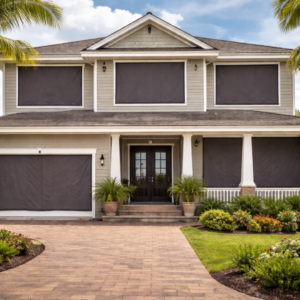
Exterior solar shades work specifically for this purpose. They roll down to block sun and reduce heat without closing off the view or the breeze. Roll-down privacy screens give you control over sightlines from the street or neighbors without making the space feel enclosed.
The lanai is also where motorized treatments make the most sense. Reaching across outdoor furniture to pull a cord gets old fast. Motorized exterior shades let you adjust them from wherever you’re sitting by remote or by phone.
It’s Okay to Mix Treatments
You don’t need to pick the same treatment for every room and you shouldn’t feel pressured to. In fact, mixing treatment types is often the smarter approach. The key is keeping some consistency in color or finish so the home still feels cohesive.
For example, white plantation shutters in the living and dining rooms pair well with soft white roller shades in the bedrooms and kitchen. The materials differ, but the palette ties everything together.
Not Sure Where to Start?
That’s exactly why we offer free in-home consultations. At Clarry Lane, we come to your home, look at each room, and help you think through what will actually work. We serve homeowners throughout Spring Hill, Tampa Bay, Wesley Chapel, Land O’ Lakes, and surrounding communities.
Schedule your free consultation with Clarry Lane →
No pressure. Just a thoughtful conversation about your home and what would make it feel more comfortable and complete.
Clarry Lane specializes in custom window treatments, closets, built-ins, and outdoor living upgrades for homeowners in Spring Hill, FL and the greater Tampa Bay area.