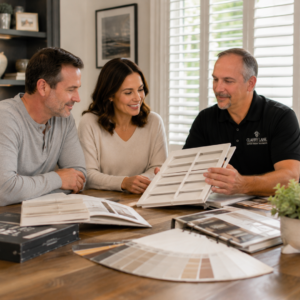
Most people start shopping for roller shades by looking at fabric swatches, colors, or prices. That’s understandable, but it’s backwards.
The homeowners who end up happiest with their shades started somewhere else entirely: they figured out what they actually needed the shade to do in that room, first.
Once you know that, everything else fabric, opacity, mount type, even price range falls into place fast. Here’s how to think it through, plus real answers to the cost and performance questions that come up once you’re ready to buy.
Start Here: What Do You Need This Shade to Actually Do?
Every roller shade decision comes down to one core question: how much light do you want in this room, and how much privacy do you need and when?
That single question determines the fabric category, which then determines almost everything else:
- Want the room bright and open during the day, with everyday privacy? Light filtering fabric. This is the default for living rooms, kitchens, dining rooms, and most home offices.
- Want the room dark, especially for sleep or screens? Blackout fabric. This is the right call for bedrooms, nurseries, and media rooms.
- Want to keep your view, cut glare and heat, but don’t need full privacy or darkness? Solar fabric. Common for home offices, sunrooms, and windows with a view worth keeping.
- Want different needs at different times of day? This is more common than people expect a primary bedroom where one person wants morning light and the other wants total darkness, for example. A layered setup with two shades, or one dual-purpose shade, solves it.
Answer that question room by room before you look at anything else. It’s the decision every guide, installer, and designer circles back to, because it’s the one that actually determines whether you’ll be happy with the shade a year from now not the color or the price tag.
Then Cost Becomes a Much Easier Question
Once you know what you need, “how much will this cost” stops being an abstract number and becomes a real budget question. Here’s what roller shades typically run:
- Basic, off-the-shelf shades: $30–$100 per window. Limited sizes and fabric choices, no custom fit.
- Made-to-measure shades: $150–$300 per window. Better fit than off-the-shelf, with more material options.
- True custom shades: $250–$450+ per window. Built to your exact measurements, with full access to premium fabrics, blackout backing, cassette headrails, and finish options.
- Motorized upgrades: Add roughly 50–100% to the base price per window, depending on the motor type and whether you’re integrating with a smart home system.
A whole-home project with 10–15 windows can range anywhere from a few thousand dollars for basic shades to well into five figures for a fully custom, motorized package. The only way to get a real number for your home is a proper measurement and consultation window size and quantity affect the total more than almost any single feature choice.
What actually moves the price:
- Fabric and opacity light filtering tends to sit lower, blackout and solar with heavier backing cost more
- Size larger windows need more material and stronger mechanisms
- Mount type outside mount uses more fabric than inside mount
- Motorization the single biggest upgrade cost, worth it for tall or hard-to-reach windows more than every window in the house
- Custom vs. off-the-shelf pre-made is cheaper but limited to standard sizes and fewer fabric choices
UV & Heat Performance: What the Numbers Actually Show
If your light/privacy answer points toward a sun-facing window, performance data matters as much as opacity especially in Florida. Here’s what’s backed by real figures:
- Windows are a major energy leak. The U.S. Department of Energy estimates that heat gain and loss through windows accounts for roughly 25–30% of a home’s heating and cooling energy use, and that about 76% of the sunlight hitting a standard double-pane window converts directly into indoor heat.
- Smart use of window coverings can cut heat gain by up to 77%. That’s the DOE’s headline figure for well-chosen, properly closed window treatments during peak sun hours.
- Solar shade fabrics block 90–99% of UV rays, which is the main reason floors, furniture, and artwork fade less in rooms with solar or blackout shades installed.
- Fabric openness drives heat performance. Solar shade fabrics are rated by “openness factor” how tightly woven the fabric is:
- 1–3% openness: Blocks roughly 90–95% of solar heat. Best for west- and south-facing windows that take the brunt of Florida’s afternoon sun.
- 3–5% openness: The most popular range for homes strong UV and heat blocking (roughly 90%+) while still preserving a clear view outside.
- 7–10% openness: More natural light and visibility, but noticeably less heat reduction better suited to windows with lighter sun exposure.
- Cooling costs can drop 15–25% in homes that use solar or blackout shades consistently on sun-exposed windows, according to industry energy studies.
In practice: a west-facing Florida window that bakes all afternoon calls for a lower-openness solar or blackout fabric it’s measurably reducing how hard your AC runs, not just adding comfort. A north- or east-facing window with milder exposure can go with a higher-openness or light filtering fabric without giving up meaningful performance.
Other Questions Worth Answering Before You Order
Inside mount or outside mount which is better? Inside mount sits flush within the window frame for a clean, built-in look, but it can allow small light gaps around the edges. Outside mount extends past the frame, which improves light blocking and privacy and can make a window appear larger, but it’s more visible against the wall. If your light/privacy answer was blackout, outside mount gets you closer to true darkness.
Should I get cordless or motorized shades? Cordless shades remove loop cords for a cleaner look and better safety around kids and pets, at little to no added cost. Motorized shades go a step further with remote, app, or voice control, especially useful for tall or hard-to-reach windows, at a higher price point.
Do custom roller shades come with a warranty? Most reputable manufacturers back custom shades with a warranty covering the fabric, mechanism, and motor (if applicable) against defects. Ask specifically what’s covered and for how long before you order, since terms vary significantly between suppliers.
How long does it take to get custom roller shades installed? Custom shades are made to order, so expect several weeks between measurement and installation, depending on the fabric and manufacturer. Worth factoring into your timeline if you’re working toward a move-in date or renovation deadline.
Are roller shades a good investment for Florida homes specifically? Yes quality roller shades with the right fabric can block up to 99% of UV rays and cut solar heat gain by 90% or more on the sunniest windows, which translates to real cooling cost savings in a climate with intense year-round sun. Matching fabric openness and mount type to each window’s sun exposure makes a bigger difference here than in milder climates.
Let’s Figure Out What Your Home Actually Needs
The light/privacy question is easy to answer in the abstract, but it plays out differently window by window once you factor in sun exposure, room use, and your household’s daily routine. That’s exactly what an in-home consultation is for we walk your space, talk through what each room actually needs, and give you a clear proposal with real numbers.
Schedule a Consultation or browse our full range of Window Treatments.